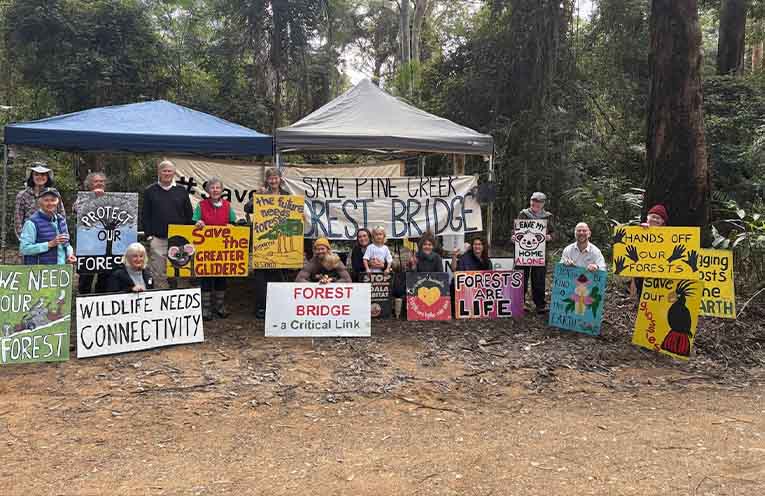
DESPITE the impending establishment of the Great Koala National Park (GKNP), local conservationists continue their fight to protect forests.
The Friends of Pine Creek have long campaigned for a forest bridge to be established.
It is a land bridge for native terrestrial and arboreal wildlife to safely move east to west, from sea level on the Pacific Coast to over 1500m altitude in the magnificent World Heritage areas of New England and Dorrigo National Parks.
The Friends are concerned that the upcoming declaration of the GKNP will see approximately 40% of the Forest Bridge under protection.
The remaining 60% is classed as “plantation” and will be available for logging, which is planned to begin shortly in some areas.
Currently, according to the Friends, there is a gap between Bongil Bongil National Park and Bindarri National Park that is occupied by small sections of Pine Creek and Tucker’s Nob State Forests.
Dr Tim Cadman has been conducting a survey of local attitudes to logging at Tuckers Nob.
He said 79% were unhappy that logging is going ahead and 91% are unhappy that remnant forest will not be marked on the harvest plan.
Two thirds of respondents said that stakeholders should be involved in clarification of what constitutes a high conservation value in a plantation.
A Friends of Pine Creek spokesperson said, “The forest bridge proposal adds the missing section to this nationally important wildlife habitat continuum of permanently conserved public forest, requiring only approximately 1650 hectares to complete.
“This corridor will become very important for native animals in mitigating the effects of a warming climate.”
The spokesperson said the Forest Bridge consisted of publicly owned native forest and plantation blocks and that many of the Pine Creek State Forest plantation blocks were indistinguishable from native forest blocks and contained significant verified koala habitat, moist sclerophyll and rainforest species and protective understorey.
“They provide vital connectivity and shelter for multitudes of species and must be considered in the ‘big picture’ of landscape linkages,” they said.
By Andrew VIVIAN