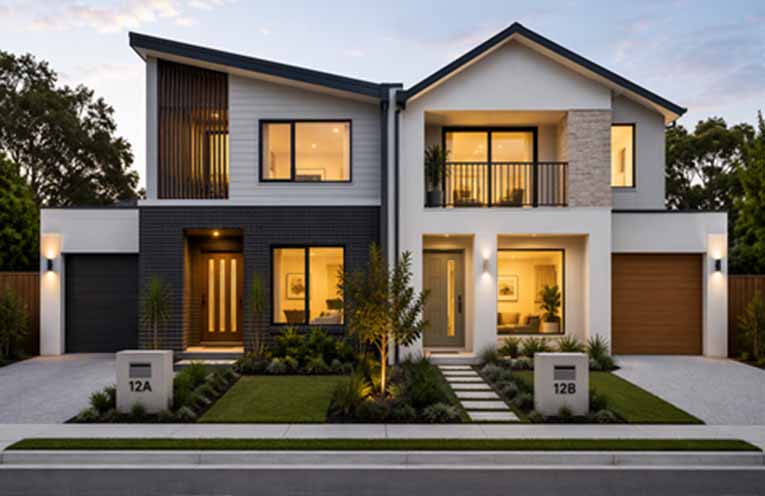
THOUSANDS more Coffs Harbour properties could become eligible for dual occupancy development under a proposed planning change aimed at increasing the region’s housing supply.
Coffs Harbour City Council has endorsed a planning proposal to remove the current 800-square-metre minimum lot size requirement for dual occupancies in R2 Low Density Residential zones.
If approved by the NSW Government, the change would increase the number of R2 properties potentially eligible for dual occupancy development from about 6000 to 11,000 – opening the door for a potential 5000 additional properties to be considered for two dwellings.
“We want to improve housing affordability, and we need to look at sensible changes that allow for more housing choice without compromising the character of our suburbs,” Mayor Nikki Williams explained on social media.
“We see this as an enabler for a greater variety and supply of housing in existing neighbourhoods,” she said.
The proposed changes were initially outlined in Council’s Local Growth Management Strategy 2020 and their Affordable Housing Strategy 2024.
“This change could make around 5000 more properties eligible for dual occupancies, helping to increase housing supply for families, downsizers, key workers and smaller households,” she said.
Importantly, removing the minimum lot size does not mean every block will automatically be able to accommodate two dwellings, explained City Planning and Communities Director, Ian Fitzgibbon.
He said Council is proposing a density control of one dwelling per 350 square metres, along with new design requirements covering issues such as setbacks, landscaping, parking, vehicular access, streetscape and residential amenity.
“We’re looking at design-based controls for dual occupancies within the R2 Low Density Residential zone, which would address matters such as built form, streetscape presentation, landscaping and residential amenity,” he said.
The planning proposal has now been lodged with the NSW Department of Planning, Housing and Infrastructure with the approval process expected to take around eight months. If approved, applications under the revised controls could be accepted from April or May next year.
Shelter NSW CEO John Engeler welcomed the move, describing it as a “much-needed start” to addressing Coffs Harbour’s housing needs, especially in consideration of increasing options that are affordable to long term renters.
“Just on 1 per cent of the population of NSW lives in the Coffs Harbour area,” he said, affirming that as a relatively large and growing city, Coffs has the opportunity to place itself as a progressive symbol of housing need for the future in NSW.
Mr Engeler said that Shelter NSW welcomes further Council reforms that specifically address housing affordability.
Meanwhile, in a related move, the Council is making efforts to secure federal and NSW government funding for a Youth Foyer in Coffs Harbour.
Cr Williams said the Youth Foyer was “a proven model that provides safe accommodation alongside education, employment and wellbeing support, helping young people build independence and brighter futures”.
By Leigh WATSON