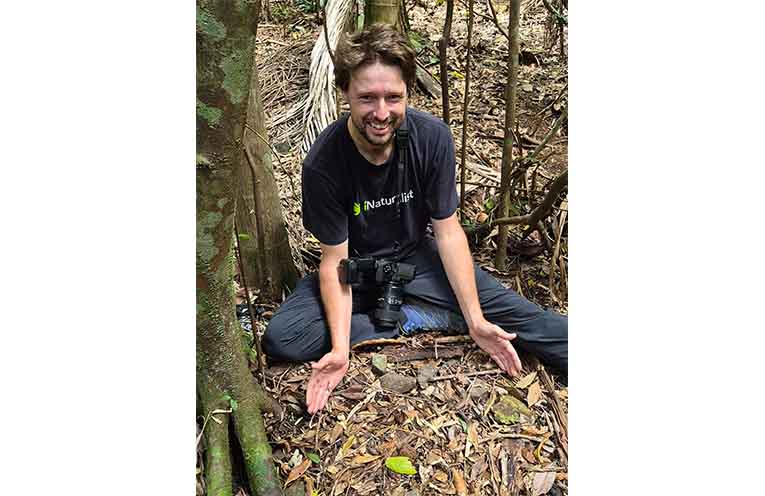
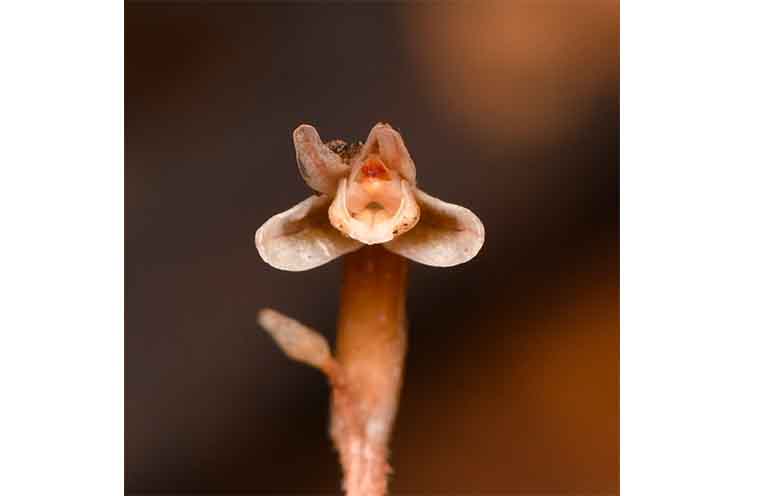
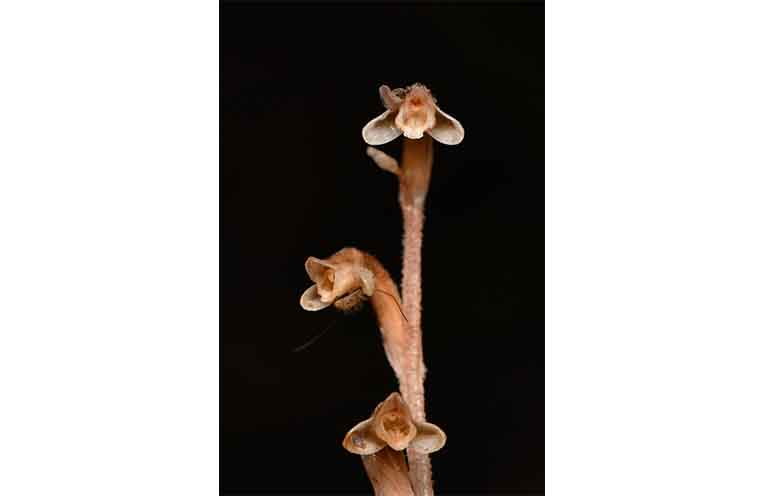
ST AUGUSTINE’S Primary School teacher and keen botanist, Nick Lambert, has discovered a second location of the critically endangered and supremely rare Bonville leafless orchid, officially named Danhatchia copelandii.
The discovery is momentous since the species was previously thought to exist only in the location it was discovered at – Bonville – and nowhere else in the world.

Mr Lambert spied the new cluster five miles away, in Boambee, where he went on search for it during its one two-week annual flowering season.
His trip out to Boambee came after inspecting the original cluster in October with his botanist friend Dr Lachlan Copeland, who discovered the species in 2018 and after whom the orchid is now named.
The original cluster of orchids was in its once-a-year above-ground appearance, flowering and in increased numbers of 17 plants, from earlier year’s recordings of just six or seven plants.
“I’ve been wanting to go and see Lachlan’s orchid for a couple of years now, so I was very excited when he told me it was flowering and invited me to come and have a look,” Mr Lambert told News Of The Area.
“Once I got my eye in for it, which is tricky because it’s so small and blends in to the leaf litter, I was pretty keen to see if I could find some for myself.
“I don’t mind a good treasure hunt-style quest and thought I’d be able to find some similar rainforest habitat nearby.”
He even had a particular spot in mind that he had visited a couple of years before.
The following day’s pouring rain did not dampen his motivation to go and try.
Nestled under the canopy of subtropical rainforest in Boambee he found it, and in good numbers.
With no leaves, the tiny 10cm tall plant is almost a needle in a haystack on the rainforest floor, but for the handful of days each year it appears above ground to flower, there’s a chance of seeing it, and Mr Lambert did.
“I was super excited to find a couple within the first 30 minutes and sent a video to Lachlan straight away,” he said.
He then spent the next couple of hours finding about 50 more within the immediate area.
“Lachlan was pumped as well and keen to come and check it out for himself, which he did the following day.”
In heightened hope of confirming the find, Dr Copeland inspected the cluster and has given a firm thumbs-up; the plants are the Bonville leafless orchid, Danhatchia copelandii.
“It’s a nice feeling to target something, particularly something rare or uncommon in certain areas, and then come up with the goods,” Mr Lambert said.
“It’s something I really enjoy doing when I have enough time.
“I’ve got lots of little quests that I’d like to have a go at when I get more time, but this one is definitely the rarest plant I’ve set out to find.”
Dr Copeland is thrilled that the new site will become part of the protected new Great Koala National Park (GKNP), which is life-changing news for the plant’s conservation and survival.
“I was really chuffed when Nick said he’d found them and in the same week that Parliament officially legislated the GKNP to go ahead.
“The plant is listed as critically endangered under Federal and State legislation; it doesn’t get much rarer than that,” Dr Copeland said.
Giving credit to Mr Lambert’s discovery, Dr Copeland said, “Nick is a fantastic naturalist with a fantastic eye for nature observation.”
Dr Copeland has contacted the National Herbarium of NSW at the Botanic Garden of Sydney where a specimen will be stored.
By Andrea FERRARI