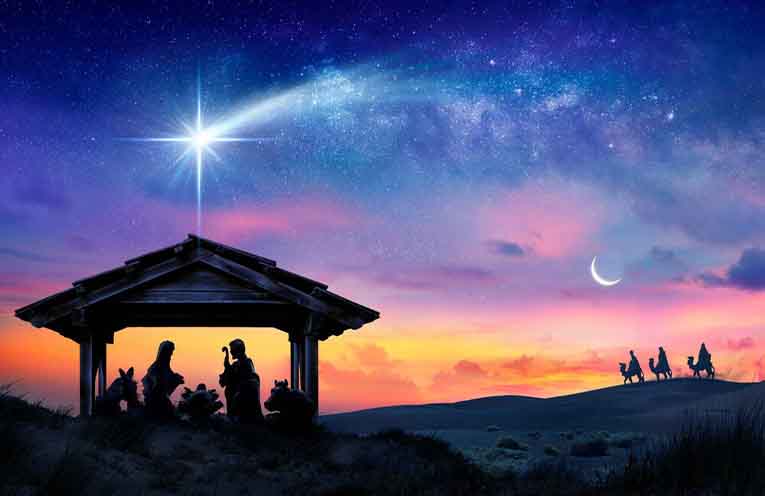
EVERY year, as the festive season picks up speed, the night sky quietly rolls out its own holiday display- no tinsel, no blinking bulbs, just a crisp dome of stars performing the same cosmic pageant they’ve been staging for thousands of years.
And woven into that ancient canvas is a tale as old as Christmas itself: the mystery of the so-called Christmas Star.
It’s easy to imagine that long-ago night, clear, cool, and still, with the kind of silence only the desert can manage.
To the east, the familiar constellations of winter marched upward: Orion with his unmistakable belt, Taurus the Bull following close behind, and the pale shimmer of the Pleiades, a cluster so distinctive even non-astronomers can spot it in a heartbeat.
It was a sky suited for wonder.
A sky perfect for a story.
But was there truly a special star?
Something bright enough, strange enough, to send travellers on a journey?
That’s where astronomy steps in, not to spoil the magic, but to show that the universe itself may have provided something extraordinary.
Historians and astronomers have been investigating this puzzle for centuries, and the contenders are more interesting than you might expect.
One idea points to a brilliant planetary conjunction, the meeting of Jupiter and Saturn in 7 BC and again in 2BC.
The two brightest planets huddled so closely together that, to the naked eye, they would have appeared as a single, unusually intense point of light.
And since Jupiter was associated with kings and Saturn with older wisdom in ancient astrology, some scholars suggest the sight may have had symbolic meaning to early skywatchers.
Another possibility is a nova or supernova, a star exploding in a surge of light so dramatic it becomes briefly visible even without a telescope.
Ancient Chinese and Korean astronomers recorded such events around the right period, and it’s entirely plausible that one of those stellar outbursts lit up the western sky for weeks.
Then there’s the idea of a comet.
Halley’s Comet swept through the inner solar system around 12 BC – too early, but not impossible if later storytellers merged events into a single narrative.
Comets, with their sweeping tails, were often seen as omens.
Some good. Some… well, less festive.
Still, the idea refuses to fade because a bright comet is, undeniably, a scene-stealer.
And here’s the twist: it might not have been one single event at all, but a series of striking sights across several years. For ancient skywatchers, who monitored the heavens with a dedication modern stargazers can only admire, the sky was a messenger.
When something unusual happened, people paid attention.
Fast-forward to today.
When we step outside on a warm December night in the Southern Hemisphere, the sky is dramatically different from that old Middle Eastern canvas.
Our summer evenings are ruled by the brilliant Southern Cross, the coal-black patch of the Coalsack Nebula, and the faint smudge of the Large and Small Magellanic Clouds, two nearby galaxies visible to the naked eye.
If your Christmas involves a backyard barbecue, chances are you’ve glanced up at these silent companions without even realising how rare they are globally.
High overhead sits Canopus, the second-brightest star in the night sky, dazzling enough to turn heads even in suburban light.
To the east, Sirius rises – whiter, sharper, and bright enough to cast a faint shadow under the darkest skies.
And if you’re up before dawn, you might catch Venus, so luminous it often gets mistaken for a UFO… or something far more biblical.
So, what does all this mean for the Christmas Star?
The beauty of astronomy is that it doesn’t try to replace wonder – it expands it.
The same laws of physics that govern planets and exploding stars also allow us to retrace the sky as it looked thousands of years ago.
Whether the star was a planetary alignment, a nova, or simply a poetic way of marking a moment, the fact remains: the sky has always been part of our story.
And maybe that’s the real magic.
Long before fairy lights and plastic reindeer, before crowded shops and digital wish lists, humanity looked upward for meaning.
The night sky connected people across cultures, across deserts, across centuries. It still does.
This Christmas, when the air cools and the stars sharpen, take a moment to step outside and look up.
The universe isn’t just overhead, it’s part of the holiday tradition too, quietly shining, just as it did the night a story began.
By David RENEKE, Astronomer