BERRY farming is a huge contributor to the Mid North Coast economy but it is under scrutiny over several areas.
One of those areas is modern slavery, and the NSW Anti-slavery Commissioner, Dr James Cockayne, has written a submission to the NSW Government detailing systemic labour exploitation in the berry industry in and around Coffs Harbour and the Nambucca Valley region.
The submission, titled ‘We are all pretending not to see the elephant in the room’, was published as part of the NSW Parliament’s inquiry into modern slavery risks faced by temporary migrant workers in rural and regional NSW.
While the submission does not make findings about specific offences or individuals, it documents extensive indicators of modern slavery and describes interlocking patterns of conduct involving labour hire syndicates, producers, and supply-chain actors that have created systemic exploitation risks for vulnerable workers.
Dr Cockayne said the information received by his Office points to a systemic problem rather than isolated incidents.
“The exploitation of vulnerable workers in regional NSW is not a new issue, nor is it confined to a handful of bad actors,” he said.
“This submission describes a system of labour exploitation that many people in the region have been aware of for years.
“Through intimidation and ineffective coordination between law enforcement and regulatory authorities, a culture of silence has taken hold.
“The submission draws on information provided by current and former workers, victims of exploitation and modern slavery, horticultural producers and buyers, service providers, unions, community organisations and government agencies.”
NOTA spoke to an American who is in Australia on a working holiday visa.
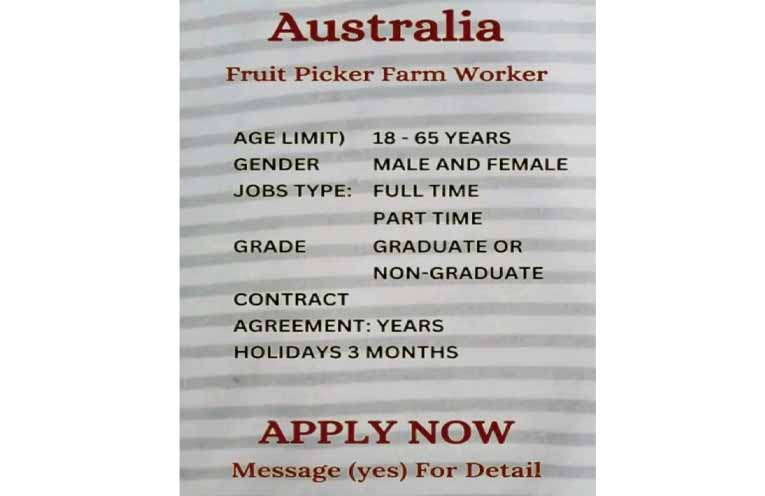
The working tourist said he looks for work on backpacking websites and saw a Facebook post which said someone was wanted who also had a car to transport other workers to blueberry farms.
He contacted the Whats App number, which took him to another Whats App contact.
He was put in touch with someone employed at a berry farm, who then directed him to a ‘manager’, who turned out to be working for someone else.
The tourist acquired a car and drove to Coffs Harbour.
He attempted to submit paperwork on his first day but picked blueberries without being able to doing so.
He said he could not get any clear answers about what was happening.
Other workers told him they were in houses with up to 17 people, paying $130 each.
The second day, he still didn’t know what he was getting paid or if his hours would be counted towards his visa.
On his third, and last, day, he transported workers to a different farm almost an hour and a half away, and worked four hours there.
He said, “There were a lot of red flags over the three days, but the straw that broke the camel’s back was being asked to submit my information on to a website that looked unsecured and very dodgy.
“That’s when I was told I wasn’t going to be paid.
“I’m not sure whether it was a scam or they didn’t know how to run a business.”
Dr Cockayne said, “Protecting workers is not only about responding after harm has occurred.
“It is about putting in place the safeguards that prevent exploitation in the first place.
“Introducing labour-hire licensing in New South Wales would improve transparency and accountability, help prevent vulnerable workers from falling into exploitative arrangements, and create a level playing field for businesses doing the right thing.”
To access advice, support or assistance relating to a possible case of modern slavery, visit the Anti-slavery Commissioner’s webpage.
By Andrew VIVIAN