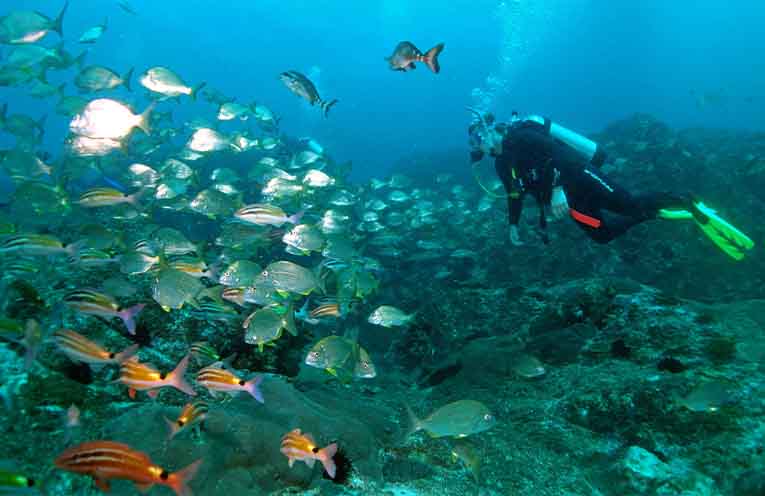
THE National Parks Association of NSW (NPA) has released a major new report into NSW’s Solitary Islands Marine Park (NSW SIMP).
The report, Solitary Islands Marine Park: Safeguarding a Unique Marine Protected Area, authored by marine scientist Iain Watt, has been prepared under a grant from the City of Coffs Harbour.
It confirms the national significance of the subtropical biodiversity hotspot, while recommending significant
improvements to the management of the Marine Park to keep pace with growing challenges to its condition and values.
NPA Conservation campaigner, Danielle Ryan, said the report arrives in a critical period when both the New South Wales and Commonwealth Governments are reviewing the management of Marine Parks.
She said, “The report highlights the broader significance of the park’s connection to the region.
“The adjoining Commonwealth Solitary Islands Marine Park and a suite of terrestrial protected areas, including the newly announced Great Koala National Park, contribute to one of Australia’s most significant ridge-to-reef conservation landscapes, spanning approximately 600,000 hectares.
Located where tropical and temperate waters converge, the park supports an extraordinary diversity of marine life, including more than 550 species of reef fish, over 100 coral species, and is intrinsically linked to local wellbeing and livelihoods.”
The report finds that, while the marine park delivers important conservation outcomes, there is an urgent need to strengthen protection to ensure the long-term health of this unique ecosystem.
NPA Coffs Coast president, Dr Grahame Douglas, said the report confirms that the park’s marine sanctuary zones support greater fish abundance, biomass and species diversity than adjacent seas.
“Marine sanctuaries punch above their weight,” he said.
“They are widely recognised as the gold standard for ocean conservation, helping marine life thrive and delivering benefits for recreational fisheries.
“The report notes that the current extent of the SIMP sanctuary zones are well below national and international conservation benchmarks. NSW SIMP’s marine sanctuaries make up only 12% of the entire park, the lowest of all East Coast state marine parks.”
A key recommendation in the report is to expand highly protected marine sanctuary zones towards 30% of the park area using best-practice marine planning principles, in line with Australia’s commitment to the Global Biodiversity Framework (GBF).
Others include establishing a formal joint management framework between NSW and Commonwealth Governments to better manage and plan across the connected Solitary Islands marine ecosystem and transferring primary NSW management responsibility into an agency with a conservation mandate to ensure management can fulfill the GBF goals.
The report also recommends embedding co-management with community, including the Yaegl and Gumbaynggirr Nations, and nominating NSW SIMP and adjoining Commonwealth marine park waters for National Heritage Listing to recognise the region’s unique values.
Ms Ryan said “I think our local Coffs community will be very excited by the idea of promoting the inshore and offshore Solitary Islands Marine Parks for heritage listing.
“The Coffs region was Australia’s first certified ECO Destination, providing a pathway to enhance our community’s credentials.
“Decisions made over the next few years will determine whether this nationally significant marine park continues to thrive in the face of increasing pressures from climate change and human impacts.”
By Andrew VIVIAN