Share via:
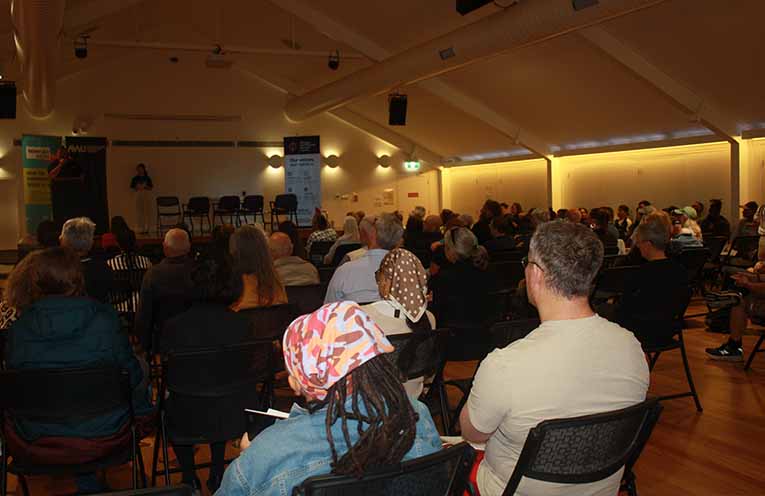
AROUND 200 people packed a forum at Cavanbah Hall recently with a clear message that the people who pick our fruit and vegetables deserve to be treated fairly, paid properly, and housed with dignity.
The forum was organised by the Australian Workers’ Union (AWU) and the newly established Refugee and Migrant Workers Centre NSW.
It comes after a recent delegation to NSW Parliament by Coffs Harbour Councillor Tony Judge and Nambucca Valley Councillor Luby Simson, along with the Anti-slavery Commissioner, seeking action on worker exploitation as reported in last week’s NOTA.
For one former farm worker who spoke out at the forum, the issues discussed were sadly familiar.
“Abu”, who asked not to be identified by his real name, came to Coffs Harbour from Malaysia with his wife about seven years ago.
Both had been nurses in Malaysia, but discovered their qualifications were not recognised in Australia and they would need to retrain.
While they worked towards new careers in aged care, they took jobs picking berries on local farms.
“At first we thought what we got paid was normal,” Abu said. “But we got a different price at every farm.”
He said that sometimes they were only told the rate of pay after they had completed the work.
“You can’t argue with them,” he said.
He explained that farmers might pay a contractor $10 a bucket, with a slow worker picking one or two buckets an hour, while a faster worker might pick three — meaning some workers could be earning as little as $10 to $15 an hour.
“This may go down as low as $5 once everyone has taken their cut,” he said.
Abu and his wife eventually moved into aged care work, but he has made it his mission to help new workers navigate the system and connect with organisations that can help them.
He said that amazingly the system he and his wife encountered has changed little in the five years.
He described a complex system involving farmers, labour-hire businesses and contractors, with sometimes multiple layers of subcontracting.
Some operated through established businesses and others appeared to be informal arrangements that were difficult for workers to identify or challenge.
Accommodation was another major concern.
He’s seen common scenarios of up to 12 people living in a suburban house, four to a room, with workers charged about $150 each for accommodation.
“Such houses are generally rented by a contractor for around $600 a week – which means they could be skimming as much as $1200,” he said.
The money for ‘rent’ is taken out of the worker’s salary before they get it – and passed on directly to the ‘contractor’ by the farm manager/owner.
Sometimes this head leasing arrangement is managed directly by a homeowner.
In other cases, he said workers were housed in sheds on farms for about $120 a week, with conditions generally poor and at times inhumane, with overcrowding, mould, dirt floors, and inadequate access to toilets and showers.
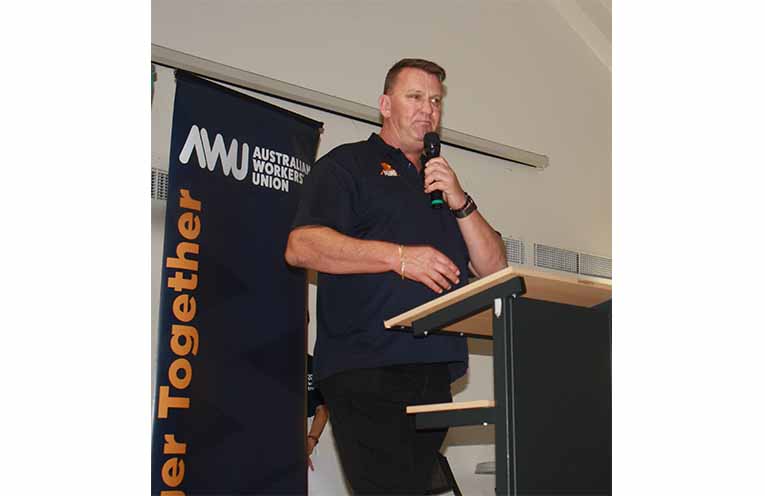
Speaking at the Forum, AWU National Secretary Paul Farrow said the Union was now conducting visits to farms in the Coffs Harbour area and would investigate allegations of underpayment and other workplace breaches.
“I will unapologetically shut down businesses exploiting workers,” Mr Farrow said.
“We’ll use whatever resources we can to bring these people to account.”
Mr Farrow said the union was particularly impressed by the community response to the forum, which had come out in force to support the workers.
“It sends the message that they’ve had enough of this kind of exploitation in the community and want it stopped,” he said.
The newly established Refugee and Migrant Workers Centre NSW is also bringing a dedicated support service to the issues that Abu outlined, providing free, confidential advice in multiple languages on issues including underpayment, unsafe work, bullying, discrimination, wage theft and visa-related workplace problems.
Mayor Nikki Williams attended the event, along with Council General Manager Murray Wood.
Mr Wood said the forum allowed Council to hear directly from the community, and to build and strengthen relationships with stakeholders including the Australian Workers’ Union.
“It was also an opportunity for other agencies to gain a greater awareness of where the City has regulatory powers, and how we can share information with one another in order to come down on the bad actors in the industry — this empowers the people doing the right thing to carry on with their quality businesses,” he said.
The strong community turnout included a large contingent from the Nambucca Valley farming community. There were also regional church representatives, who said they regularly step in to help temporary migrant workers with emergency accommodation, food and other support.
As the community came together, the message was clear — the people who put food on our tables should not have to sacrifice their wages, safety or dignity to do it.
Both organisations behind the forum are inviting community members to contact them with any concerns about local conditions.
Community members can contact the Australia Workers Union by emailing paul.farrow@nat.awu.net.au.
Migrant workers can call 1300 513 107 or email hello@migrants.org.au.
By Leigh WATSON
You can help your local paper.
Make a small once-off, or (if you can) a regular donation.
We are an independent family owned business and our newspapers are free to collect and our news stories are free online.
Help support us into the future.
Share via: