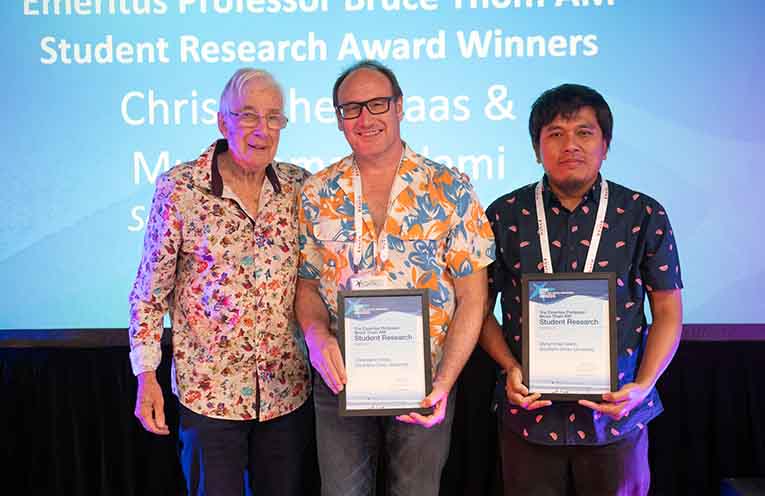
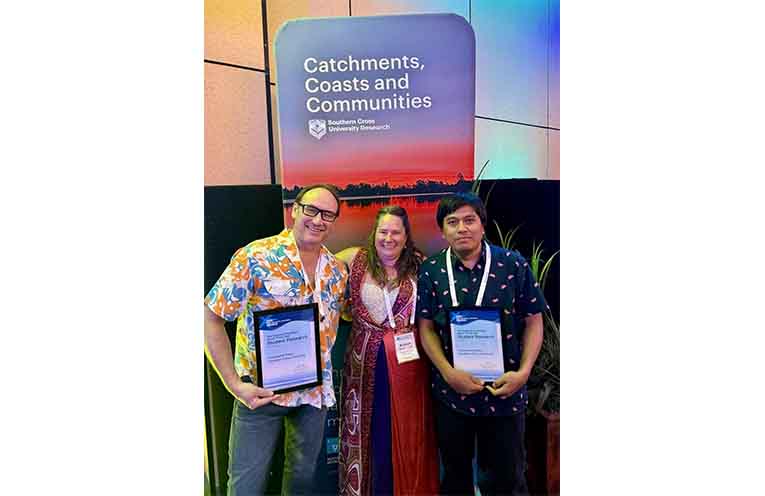
TWO PhD candidates from Southern Cross University (SCU), Chris Klaas and Muhammad Islami, who are studying at the National Marine Science Centre in Coffs Harbour, have been named joint recipients of the Emeritus Professor Bruce Thom AM Student Research Award.
This award recognises academic research with the potential to make a positive impact on coastal management.

Professor Bruce Thom, the founding father of the Australian Coastal Society and for whom the award is named, was on hand to congratulate the SCU duo at the 2025 NSW Coastal Management Awards in November at Ballina.
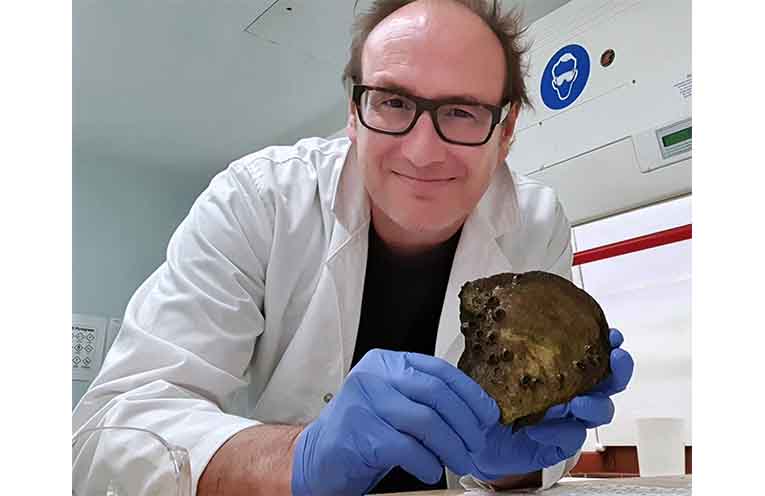
Professor Thom commended Chris for his pioneering journey of discovery with the native leaf oyster (Isognomon ephippium).
“Particularly in the field of its sex life, Chris is working his way through the whole reproductive system and learning about how things are cultured because we know so little about the leaf oyster,” Professor Thom said.
“The work started from his Honours project and it’s developing into a very sophisticated PhD project.
“Chris is looking at optimal sites which could have conservation interests or restoration interests… likely to be a lifetime’s work.”
Praising Muhammad’s revolutionary research, Professor Thom said he has brought to ecological work two incredibly important skills.
“One, which is now rare in many ways, and that’s as a parataxonomist – a taxonomist of macroinvertebrates.
“And to be able to devote your life to the taxonomy of anything, I think is an incredibly important thing.”
He’s also specialising in environmental DNA work.
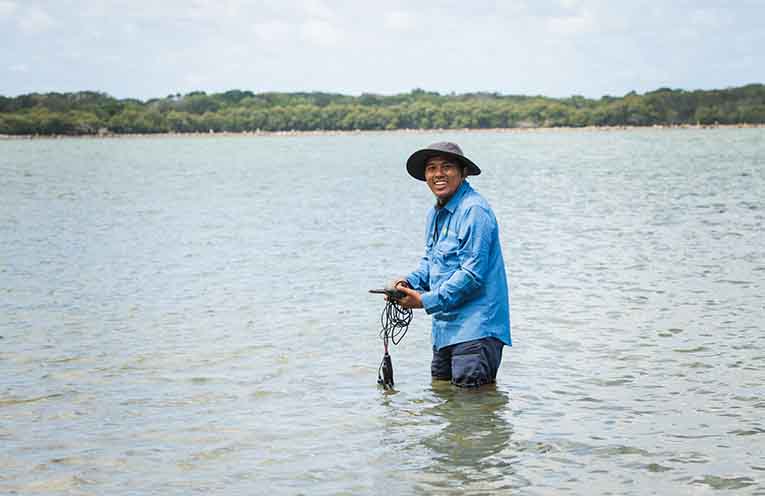
By bringing those two techniques together, Muhammad was investigating the role of macroinvertebrates in estuarine systems to assist in the monitoring of waterway health, particularly in the post-recovery phases after a flood.
“Muhammad is developing more efficient ways of collecting and analysing data that will help us understand better where the recovery rates, in terms of the ecological systems, are occurring faster than others, and where we need to look more seriously at the problems of depletion and damage.”
Both Chris and Muhammad acknowledged that pursuing a PhD was challenging yet ultimately rewarding.
Chris said that a PhD journey can feel solitary at times, especially when working deeply within a knowledge gap sometimes only known by a small number of people.
“It is incredibly rewarding to see my research on Isognomon ephippium (also known as the leaf oyster) recognised for the potential these oysters hold as ecosystem engineers.
“Expanding our understanding of new candidate species for oyster reef restoration is essential for extending restoration efforts into new locations and habitats.
“By studying I. ephippium’s recruitment patterns, reproductive cycle, and physiochemical tolerances, we can help secure its place in future multi-species shellfish reef restoration.
“These oysters have great potential to enhance broader ecological restoration efforts across a wide range of habitats,” he said.
An international student, Muhammad’s PhD looks at how floods and other pressures affect estuarine macrobenthic biodiversity in northern NSW.
“Having this work recognised feels very encouraging,” he said.
“It motivates me to keep learning and I’m sure the knowledge and experience I’m gaining here will be valuable for addressing similar environmental challenges back home in Indonesia.”
Chris and Muhammad were nominated for the award by their supervisor Professor Kirsten Benkendorff, also based at the National Marine Science Centre at Coffs Harbour, from the University’s Catchments, Coast and Communities research cluster.
Professor Benkendorff said the recognition for the innovative research that Chris and Muhammad are doing is “amazing”.
“It is also fantastic to hear Emeritus Professor Bruce Thom’s appreciation for the importance of traditional taxonomy and life history research, which these PhD students are coupling with modern technology such as environmental DNA and real-time water quality monitoring in sophisticated field experiments.”
By Andrea FERRARI