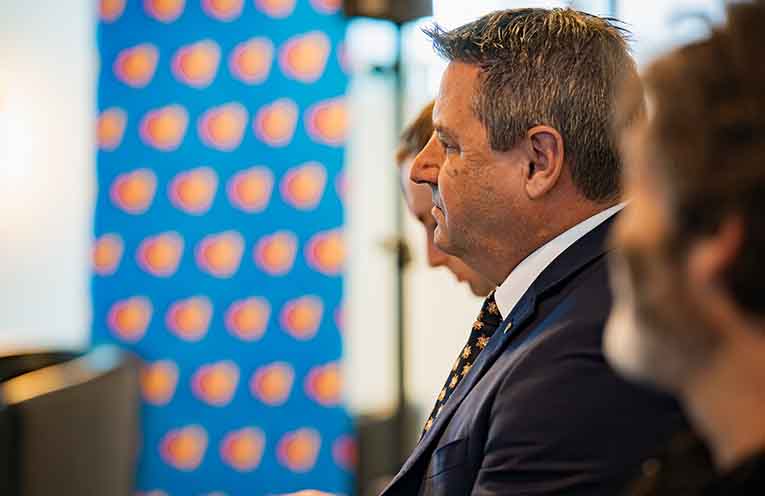
NATIONALS Member for Cowper Pat Conaghan reckons the Labor Government’s Federal Budget fails “the pub test”.
In his response to Treasurer Jim Chalmers’ far-reaching measures, delivered on 12 May, Mr Conaghan said benefits would not be realised for several years.

“The signature cost-of-living piece in Jim’s budget announcement is an ongoing $250 tax offset for more than 13 million working Australians, starting in 2027–28,” he said.
“That means Aussie workers won’t see that in their pocket until after July 2028.
“Conveniently after the next Federal election.
“So we can’t hold them accountable for them anytime soon.
“Labor claims to be helping more Australians into home ownership with their broken promises on Capital Gains tax and Negative Gearing for landlords.
“But are simultaneously set to increase migration levels, putting additional strain on limited housing supply and overstretched infrastructure.”
Key measures
In a joint statement, the Treasurer, Prime Minister Anthony Albanese and senior ministers, described the Budget as being about “resilience and reform.”
“It’s all about getting Australians through the global oil shock and building an economy that works for more people.
“We’re delivering more cost‑of‑living help and building a more productive economy, a better tax system, a fairer housing market and a stronger and more sustainable budget,” the statement read.
The Budget focuses on cost-of-living relief, housing tax reform, and energy security.
A $31.5 billion deficit is forecast with $45 billion in improved revenue.
Key measures include:
– Income Tax Cuts: From July 1, 2026, the 16% tax rate for incomes $18,201–$45,000 drops to 15%.
– Worker Offset: A new $250 permanent Working Australians Tax Offset and a $1,000 instant tax deduction for work-related expenses.
– Medicare: Increased Medicare levy low-income thresholds.
– Negative Gearing: Limited to new builds, with existing investments grandfathered.
– Capital Gains Tax (CGT): The 50% CGT discount is scrapped and replaced by an indexation system to target real gains.
– Securing Australia’s near‑term fuel and fertiliser security through Export Finance Australia’s $7.5 billion Fuel and Fertiliser Security Facility.
– Strengthening longer term fuel security with a $3.2 billion Australian Fuel Security Reserve.
– Boosting energy sovereignty by making more clean fuels in Australia, promoting electrification, and implementing a 20 percent gas reservation.
– Approvals: $500 million-plus to expedite environmental and project approvals using AI.
Business body responds
Business NSW Mid North Coast says the Federal Budget delivers some welcome certainty for small and medium businesses but does little to address the underlying confidence and capacity challenges facing regional economies.
While Business NSW has welcomed certainty on the instant asset write‑off and measures to improve domestic gas supply, regional businesses continue to face rising costs, infrastructure constraints and workforce shortages that are limiting growth and investment.
Business NSW Mid North Coast Regional Director Rod Barnaby said the Budget contains important but incomplete measures for regional NSW.
“Certainty on the instant asset write‑off is positive and long overdue, particularly for regional businesses that rely on plant, equipment and vehicles to operate,” Mr Barnaby said.
“But confidence across the Mid North Coast remains under pressure.
“Our businesses are still grappling with high energy and fuel costs, skills shortages and a lack of enabling infrastructure to support growth.”
In terms of housing and infrastructure, Mr Barnaby said the Budget’s $2 billion investment in water and sewer infrastructure to support up to 65,000 new homes has the potential to be highly beneficial for the Mid North Coast, if regional projects are prioritised and delivered quickly.
“Housing affordability and supply is now a core economic constraint for regional businesses,” he said.
“Without investment in local water, sewer and enabling infrastructure, we cannot unlock land, attract workers or support business expansion.
“Regional NSW must see a fair share of this funding translate into shovel‑ready projects.”