A LOWANNA resident is calling on the City of Coffs Harbour to stop the pollution of creeks near his home.
The man, who News Of The Area is not naming for privacy reasons, grew up on the property and has returned to raise his own family.

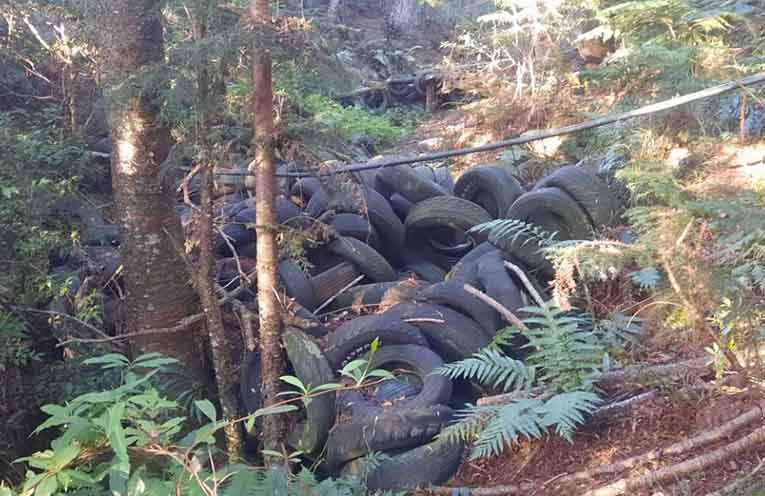
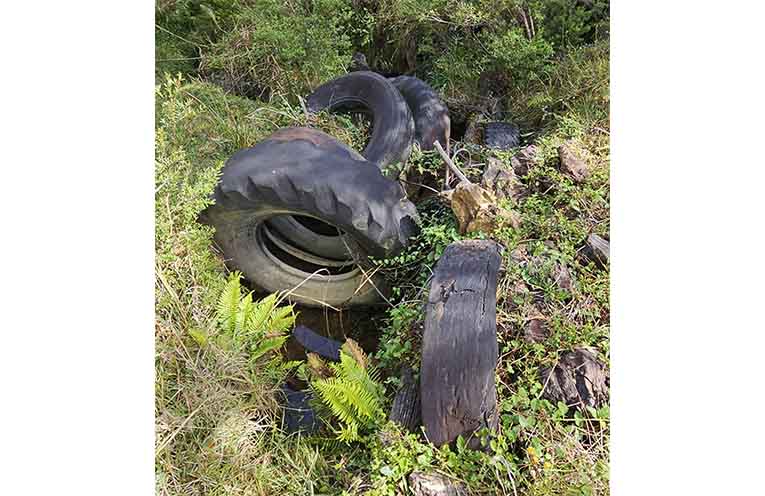
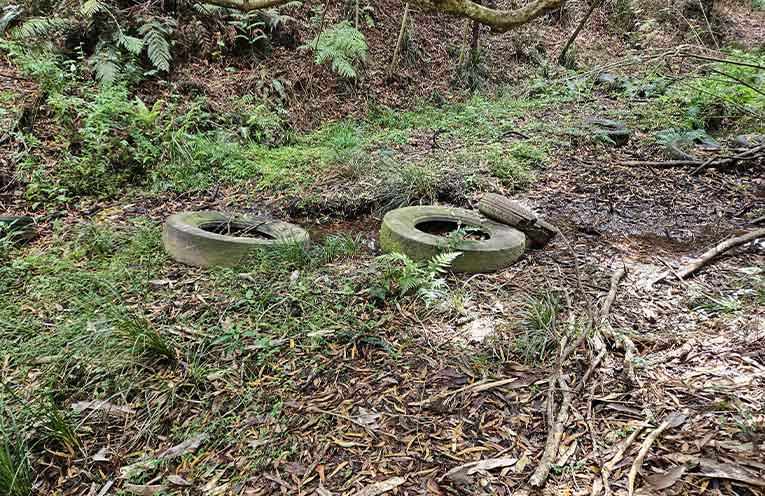
He has found hundreds of dumped tyres and fears they are polluting the creek that runs through the property.
Some of the tyres show manufacture dates between 2018–2022, and have appeared at a location historically used as a dumping site.
It is unclear how many tyres were dumped at various periods, but the total number is estimated to be in the hundreds.
The resident reported the issue to Council in 2022 – though he has been told they have no record of that – then again in August 2024.
He also reported the dumping to the NSW Environment Protection Authority (EPA) and NSW Crown Lands.
After some initial communication, responses from these organisations ceased a few weeks later, leaving the matter unresolved.
In early 2026, the resident again approached Council, speaking with the General Manager.
A Council officer then inspected the site in late April.
Under the NSW Protection of the Environment Operations Act 1997, waste tyres are classified as “special waste” and can only be disposed of in approved facilities.
Penalties for illegal dumping of waste can range from $1000 to $2,000,000 for individuals and $5000 to $4,000,000 for corporations.
Prison sentences may be imposed where parties are found to have engaged in wilful or negligent disposal that causes actual or likely harm to the environment.
NOTA asked a Council spokesperson how long they had known about the problem, how long a clean-up would take and who would be responsible for clean-up costs in that location.
Council provided the following response: “The City is currently investigating an allegation of illegal dumping of tyres on a private property in Lowanna.
“As the investigation is ongoing, the City is unable to provide any further comment at this time.”
Tyre dumping is a widely reported problem around Australia, with advocacy group Tyre Stewardship Australia noting the financial burden often falls on taxpayers through costly council-led remediation.
NOTA spoke with Griffith University ecotoxicologist Professor Frederic Leusch about the environmental impact of tyre dumping.
“Zinc is the biggest problem in this type of situation, because it is present in really high concentrations in tyres and can be very toxic to crustaceans and fish,” he said.
“There’s actually a suite of contaminants that are present in tyres and could present a risk to living organisms.
“My top five of concern would be zinc, benzothiazoles, Polycyclic Aromatic Hydrocarbons (PAHs), 6PPD-quinone and microplastics.”
Professor Leusch noted other significant impacts include changes in hydrology, removal of habitat for freshwater organisms, microbial pathogen growth from stagnant water and damage to riparian areas.
According to Professor Leusch, the removal and rehabilitation of large-scale dumping in waterways is often very challenging and costly.
“That’s where being able to come in and remedy the situation quickly is really important because these things don’t just disappear, and they get harder to remove as time goes on,” he said.
The resident who contacted NOTA said that after undertaking some basic independent testing he was considering saving up for more detailed analyses.
“I’m not sure who’s meant to be responsible for this, I can’t really afford to spend money on testing but no-one else is going to do it,” he said.
“No-one seems to care about the cost and health impacts to the families and farms downstream.”
By Jessica MILLER